Beyond the Checkbox: Meaningful Use’s History and Development
Paper charts, a patchwork of handwritten notes, lab findings, and discharge summaries, used to include a patient’s complete medical history during the quiet hours of a clinic or hospital. Despite being well-known, this system was fragmented, prone to mistakes, and a significant hindrance to effective, coordinated care. Healthcare was still heavily dependent on the slow pace of physical records in a time when information is moving at the speed of light.
The Meaningful Use program, one of the most important and contentious government programs in contemporary healthcare history, was made possible by this challenge. More than just digitizing patient information was the goal of the program, which was started in 2009 as part of the Health Information Technology for Economic and Clinical Health (HITECH) Act.
Its bold objective was to encourage the “meaningful use” of certified Electronic Health Record (EHR) technology in order to radically alter the American healthcare system. Building a digital basis for the future of medicine and overcoming ten years of technological immobility was a daring endeavor.
The Origins of the Digital Age

Not a stand-alone policy, the Meaningful Use initiative was a component of the HITECH Act, which was a part of the large economic stimulus package known as the American Recovery and Reinvestment Act of 2009 (ARRA).
The reasoning was straightforward: the government could speed up a digital revolution that would improve patient care, lower medical errors, boost public health surveillance, and save administrative expenses by providing financial incentives to healthcare providers who successfully implemented and used EHRs.
Fundamentally, Meaningful Use was a three-phase, planned program that gave providers progressively more difficult goals to achieve. Hospitals and eligible professionals had to prove that they were using an EHR and that their use was actually “meaningful”—as defined by a long number of precise metrics—in order to be eligible for incentive payments from Medicare and Medicaid.
The Meaningful Use Three Stages

In order to promote deeper involvement and more advanced use of EHR technology, the program was created as a progressive journey, with each level building upon the one before it.
Stage 1: Foundational Steps (2011)
The first stage concentrated on the fundamentals of information sharing and data collection. The goal was to establish the foundation for a digital healthcare ecosystem and to acquaint providers with the essential features of an EHR. Important prerequisites were as follows:
Computerized Provider Order Entry (CPOE): Using the EHR to enter medical orders (such as lab tests and imaging requests), thereby reducing errors and improving workflow.
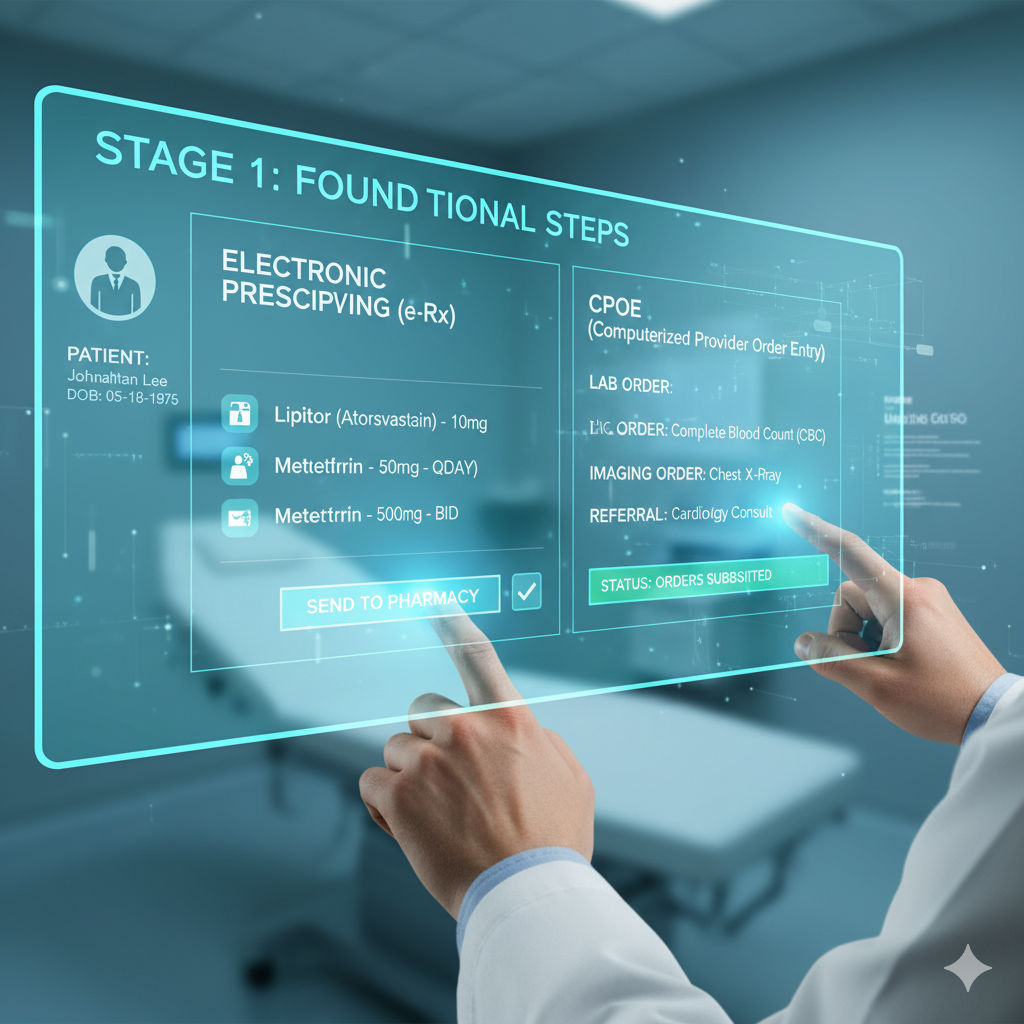
Recording key patient demographics: Gathering and storing vital information like race, ethnicity, and preferred language.
- Sending prescriptions electronically to pharmacies, which decreased the risk of medication errors due to illegible handwriting.
- Providing electronic copies of health information:* Making patient data available to individuals upon request.
Proving that providers could use the EHR to enhance fundamental clinical procedures and start the transition to a paperless environment was the goal of this stage. Data entry and the initial phases of interoperability were the main topics.
Stage 2: Advancing Clinical Processes (2014)
This phase, which built on Stage 1, encouraged physicians to use EHRs at a higher degree while focusing on patient engagement and safe data sharing with other providers.

More patients had to fulfill stricter requirements, and the measures grew more stringent. Important prerequisites were as follows:
- Clinical decision support: Using the EHR to leverage data and give clinicians customized recommendations or alerts to improve care.
- Interoperability: Requiring the electronic exchange of patient summaries between various healthcare providers and systems.
- Secure messaging: Enabling patients to message their providers and vice versa, fostering better communication.
- Patient portals: Giving patients online access to their health information, including lab results and clinical summaries, through a secure portal.
In order to build a healthcare network that is genuinely connected, this was an essential step. The focus shifted from merely digitizing data to leveraging that data to empower patients and assist care coordination in Stage 2, which was a significant advancement.
Stage 3: Improved Outcomes (2018)
The program’s last and most ambitious phase sought to improve population health management and patient health outcomes. It was intended to completely integrate EHRs into the provision of healthcare, going beyond their transactional function.

Since many providers found it difficult to fulfill Stage 2’s strict requirements, Stage 3 was created to concentrate on:
The integration of wearable and home monitoring data into the patient’s electronic health record (EHR) is an example of patient-generated health data.
- API access: By providing patients and third-party apps with access to their health information through application programming interfaces (APIs), a new generation of patient-centered applications is made possible.
- Public health reporting: Automatically sending data to public health registries to assist in monitoring and controlling disease outbreaks. The program’s goal of a fully integrated, patient-centered, and data-driven healthcare system was embodied in Stage 3.
But there were major obstacles to its implementation, which finally caused the program to change.
The Concrete Effect: Advantages and Innovations
There is no doubting that Meaningful Use had a significant and enduring influence on the healthcare system in the United States, notwithstanding its detractors. Widespread adoption of EHRs was effectively sparked by the program, which had previously languished for years. From about 9% in 2008 to over 80% in 2014, the proportion of hospitals utilizing a basic EHR system increased dramatically in just ten years.
The advantages of the program were substantial:
- Enhanced Patient Safety: Meaningful Use reduced medication and treatment errors, a leading source of patient harm, by digitizing prescriptions and orders. It became commonplace to receive alerts for possible interactions or drug allergies.
- Enhanced Coordination of Care: Improved contact between clinics, hospitals, and specialists was made possible by the data exchange requirements. This resulted in fewer unnecessary tests and more informed judgments by enabling a patient’s primary care provider to promptly obtain recent test findings from a hospital stay.
- Enhanced Patient Involvement: People now have unparalleled access to their own health information, enabling them to play a more active role in their care, thanks to the drive for encrypted messaging and patient portals.
- Improved Health of the Population: The initiative made it simpler to spot outbreaks, follow illness patterns, and keep a broad eye on public health measures by requiring electronic data input to public health registries.
The Unexpected Difficulties and Remarks
Despite being revolutionary, Meaningful Use was far from flawless. A number of significant complaints and unintended outcomes resulted from the program’s strict, metric-based structure:
- The “Checkbox” Mentality: Rather than genuinely concentrating on enhancing patient care, providers frequently felt pressured to “check a box” in order to satisfy a certain need. Qualitative gains in patient outcomes were frequently eclipsed by the focus on quantitative metrics.
- EHR Usability Issues: A lot of EHR systems were not made to be clinically effective or user-friendly, but rather to satisfy Meaningful Use standards. This resulted in clumsy user interfaces, a lot of clicking, and a practice called “pajama time,” where doctors would spend hours after work taking notes on patients.
- Provider Burnout: Physician burnout was mostly caused by a mix of strict regulations, cumbersome software, and the administrative strain of documenting for rewards. Data entry took precedence over face-to-face patient interaction.
- Lack of Flexibility: Because psychiatry and surgery have very diverse workflows and demands, the one-size-fits-all Meaningful Use strategy was not a good fit for these therapeutic specialties.
The Legacy and Development: From Meaningful Use to MIPS
It became evident that the program needed to change by the middle of the decade. A significant change in policy resulted from the complaints and the heavy load on suppliers. The Medicare Access and CHIP Reauthorization Act (MACRA), passed by Congress in 2015, combined a number of earlier incentive schemes into the Merit-based Incentive Payment approach (MIPS), a new performance-based approach.
Meaningful Use was renamed “Promoting Interoperability” under MIPS. This significant name change represented a philosophical shift, with the new program emphasizing the smooth transfer of patient data between various healthcare systems rather than the quantity of EHR features utilized.
Quality, Improvement Activities, Cost, and Promoting Interoperability are the four areas in which the new MIPS framework evaluates providers. Instead of a strict set of technology requirements, this new structure provided more flexibility and a stronger emphasis on patient outcomes and value-based treatment.
A Prospective View
The Meaningful Use program’s transformation from a ground-breaking requirement to a new, more adaptable approach serves as a compelling illustration of the difficulties involved in extensive healthcare reform.
Despite its shortcomings, it unquestionably achieved its main goal, which was to initiate the digital revolution in American healthcare. It established the groundwork for the current norm of data-driven, patient-centered, interoperable care models.
The work is still ongoing today, expanding upon the framework that Meaningful Use contributed to. In order to genuinely improve the quality and accessibility of treatment, the emphasis has shifted from simple adoption to optimizing EHRs, improving interoperability, and utilizing technology.
The program’s influence extends beyond the EHRs that are now found in every clinic; it also includes the long-lasting mentality change away from disjointed paper records and toward a connected, digital healthcare future.
Recent Posts
- The Ultimate Showdown: Electrolysis vs. Laser Hair Removal – Which is the Right Choice for You?
- Your Digital Pathway to Fitness Expertise: The Definitive Guide to Personal Training Certification Online
- Redefining Confidence: Your Comprehensive Guide to Breast Augmentation Houston
- Beyond the Garden State Glow: Your Definitive Guide to Laser Hair Removal in NJ
- San Diego Sunshine: Your Guide to Laser Hair Removal San Diego and Effortless Beach-Ready Skin
Recent Comments
